
PARPi Response Prediction with Pillar Biosciences’ oncoReveal Geentic and Epigenetic Alteration Panels
Event Name: AMP 2021
TBC
Accelerating Precision Medicine with Rapid Front-Line NGS
Event Name: AMP 2025
TBC
Laboratory Validation of Pillar’s onocoReveal Myeloid Panel on the Illumina MiSeq i100 to Deliver Rapid Front-Line NGS for Heme Malignancies
Event Name: AMP 2025
TBC
Pillar Biosciences Enables Rapid, Localized Tumor Profiling of Lymphoid Malignancies with Launch of New Kitted NGS Panel
NATICK, Mass. – November 11, 2025– (PR NEWSWIRE) – Pillar Biosciences, Inc., the leader in Decision Medicine™, has announced the launch of oncoReveal® Lymphoid, a research-use-only (RUO) next-generation sequencing (NGS) kit designed to enable laboratories to perform rapid tumor profiling of lymphoid malignancies. The oncoReveal Lymphoid panel interrogates 84 genes of interest, including full coding […]
Improving Access to NGS-Based Liquid Biopsy Testing for Advanced Cancers

Publishing Entity: GenomeWeb | Precision Medicine Online
TBC
Optimizing Your Lab’s Precision Medicine Strategy Through Rapid, Front-Line NGS
Publishing Entity: Dark Daily
TBC
Diagnostics, access, therapies on minds ahead of ASCO
Publication Source: CAP TODAY
TBC
Validation and Performance of Quantitative BRCA1 and RAD51C Promoter Hypermethylation Testing in Breast and Ovarian Cancers
Publication Source: The Journal of Molecular Diagnostics
TBC
Detecting Ultra-Low Frequency ESR1 Mutations in Liquid Biopsy Samples Using the oncoReveal Essential LBx Panel
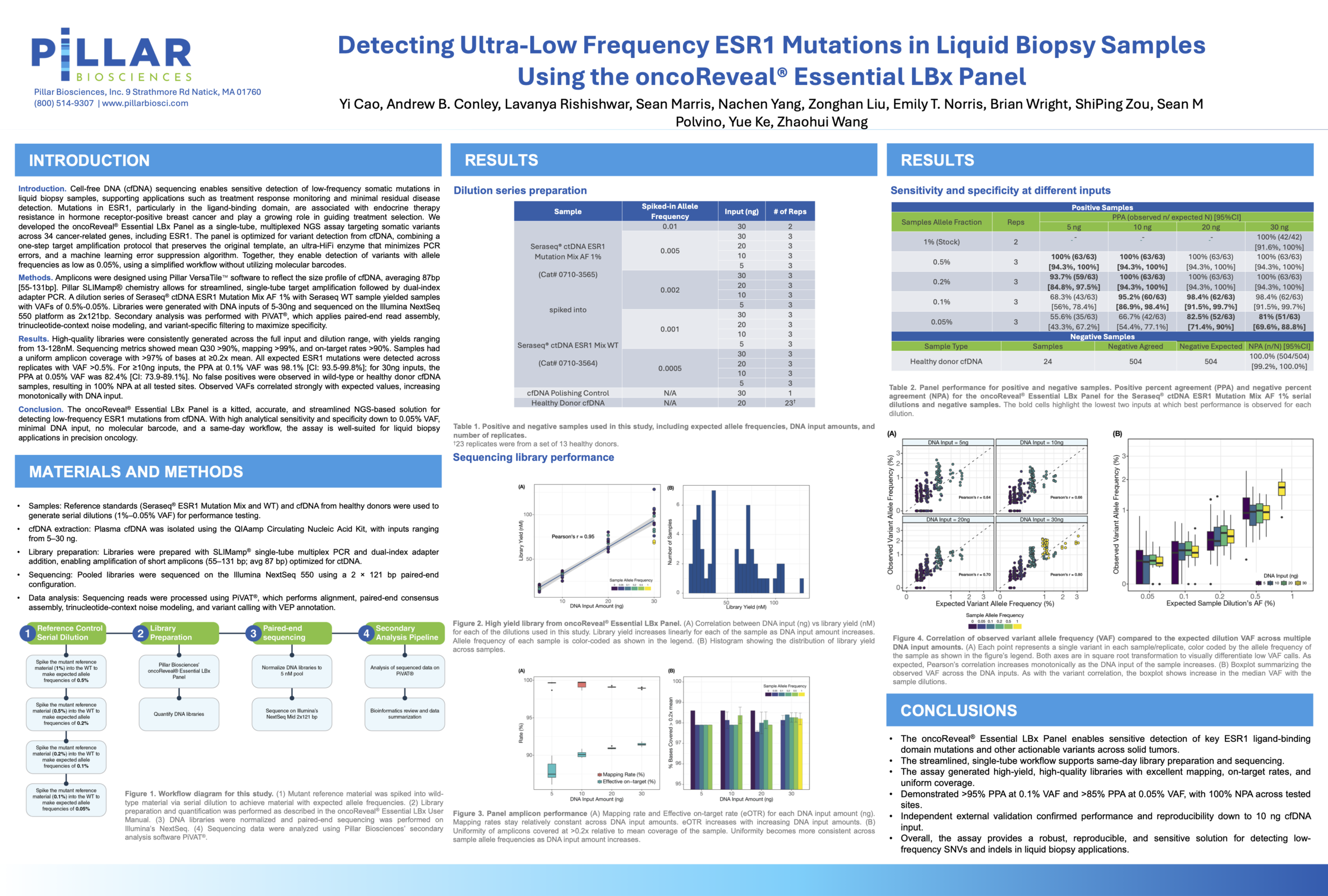
The oncoReveal® Essential LBx Panel is a single-tube, 34-gene amplicon-based NGS liquid biopsy assay built on SLIMamp® chemistry. Pillar tested it on Seraseq® ctDNA ESR1 reference standards diluted to 0.05% variant allele frequency (VAF) from 5–30 ng of plasma cell-free DNA (cfDNA), sequenced on the Illumina NextSeq 550 and analyzed with PiVAT® software. It detected these endocrine-therapy-resistance mutations in HR-positive breast cancer with 98.4% PPA at 0.1% VAF and 100% NPA — no molecular barcodes (UMIs) required.
Detecting Contamination in Cell-free DNA Sequencing Libraries using Germline Markers
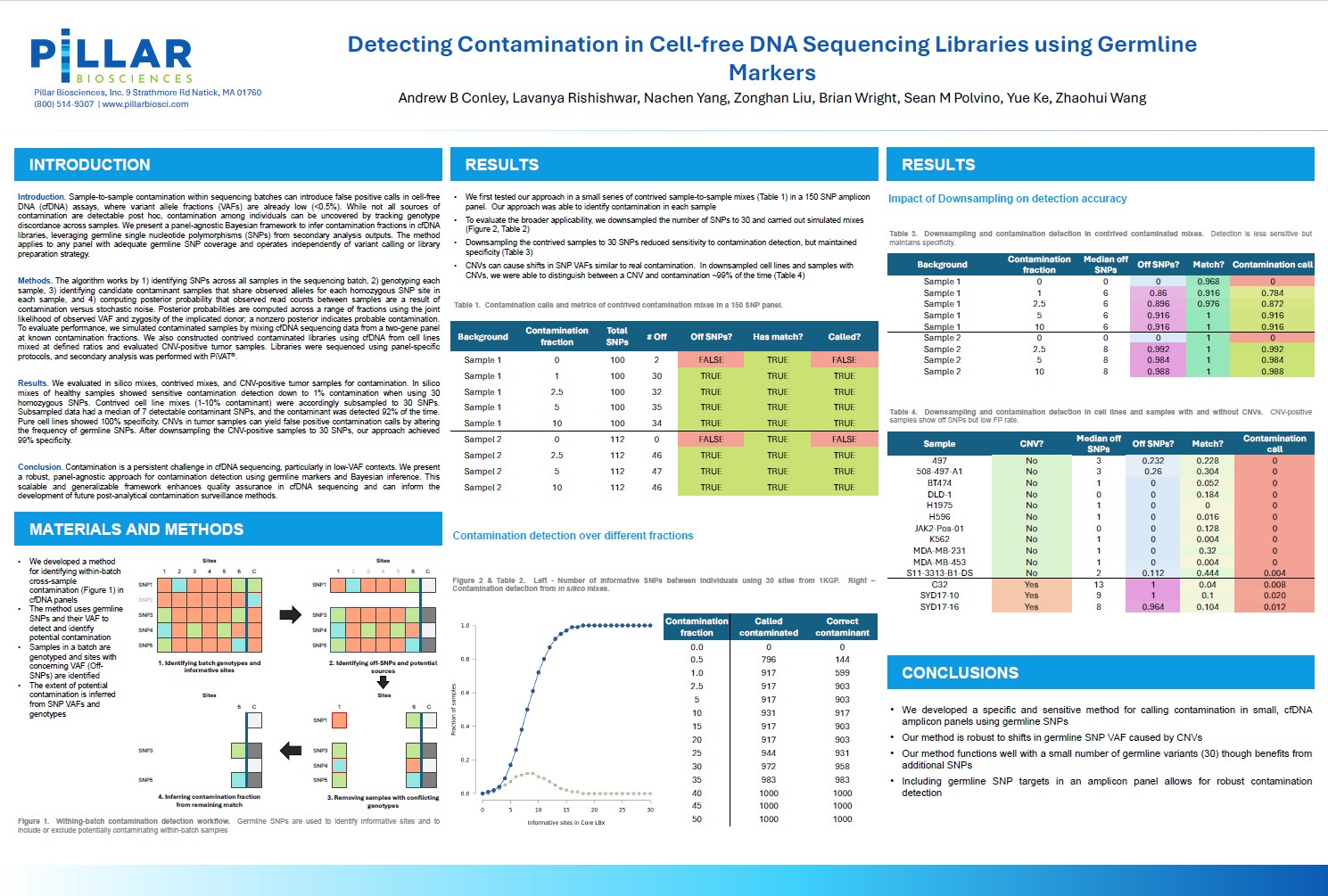
Pillar developed a panel-agnostic Bayesian method to detect sample-to-sample contamination within cell-free DNA (cfDNA) sequencing batches, where variant allele fractions below 0.5% make false positive calls especially costly. The algorithm genotypes germline single nucleotide polymorphisms (SNPs) across a batch, flags sites with discordant allele fractions, and computes the posterior probability that observed read counts reflect contamination rather than stochastic noise. Across in silico mixes, contrived cell line mixes, and CNV-positive tumor samples it detected contamination down to 1% using 30 homozygous SNPs while holding 99–100% specificity.