
Utilizing Pillar Biosciences’ Rapid oncoReveal 4-Gene Methylation Panel to Guide PARPi Therapy in Breast Cancer Patients
Event Name: AMP 2024
TBC
The Simple Verifiation in a Molecular Pathology Lab of the FDA Approved oncoReveal CDx Pan-Cancer Solid Tumor IVD Assay
Event Name: AMP 2024
TBC
Streamlining the Clinical Laboratory Workflow of Myeloproliferative Neoplasms with Next-Generation Sequencing

Publishing Entity: GenomeWeb | Precision Medicine Online
TBC
Targeted NGS as a Front-Line Strategy to Accelerate the Delivery of Precision Medicine for Solid and Heme Tumors
Publishing Entity: GenomeWeb | Precision Medicine Online
TBC
Accelerating Access to Liquid Biopsy Testing with Kitted NGS Solutions

Publishing Entity: GenomeWeb | Precision Medicine Online
TBC
Performance of oncoReveal MLH1 & MGMT Methylation Panel from Pillar Bioscience
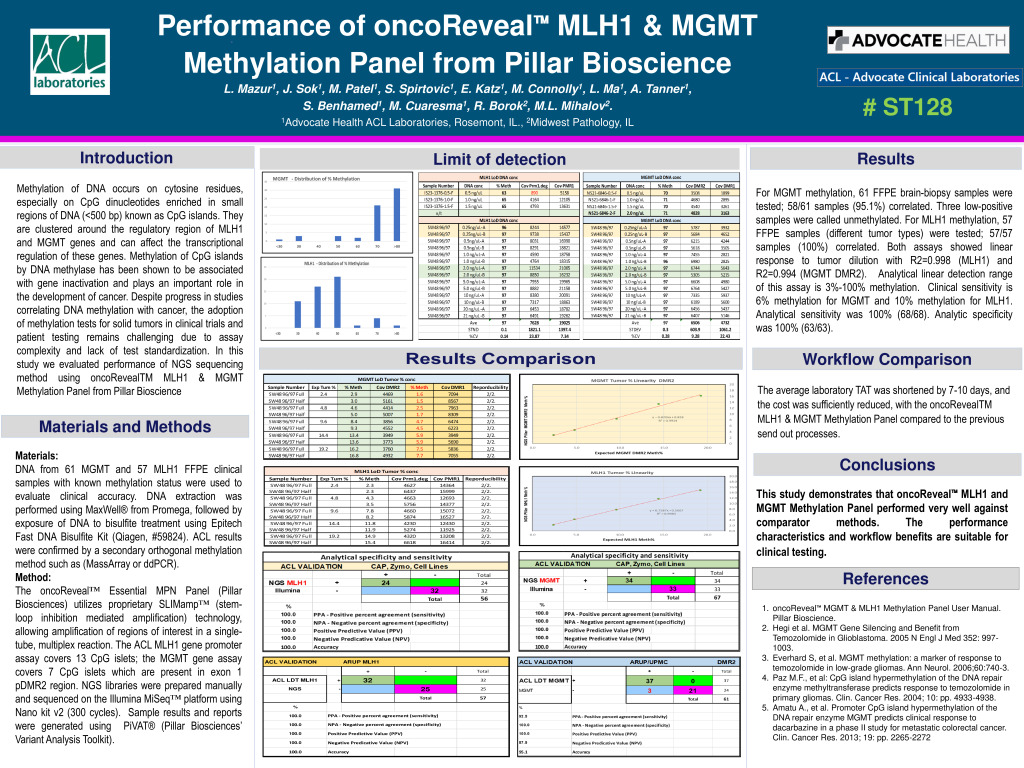
Advocate Health ACL Laboratories evaluated Pillar’s oncoReveal® MLH1 & MGMT Methylation Panel, a bisulfite-based NGS assay using SLIMamp® chemistry to quantify promoter CpG island methylation — the gene-silencing marker that predicts temozolomide response in glioma and supports Lynch syndrome workup. DNA from 61 MGMT and 57 MLH1 FFPE clinical samples of known methylation status was bisulfite converted, sequenced on the Illumina MiSeq, analyzed with PiVAT®, and confirmed by orthogonal MassArray or ddPCR. MLH1 correlated 100% and MGMT 95.1%, with laboratory turnaround shortened by 7–10 days versus the prior send-out process.
Assessment of Homologous Repair Deficiency status in Triple Negative Breast and Ovarian Carcinoma using Genetic and Epigenetic Next Generation Sequencing Assays
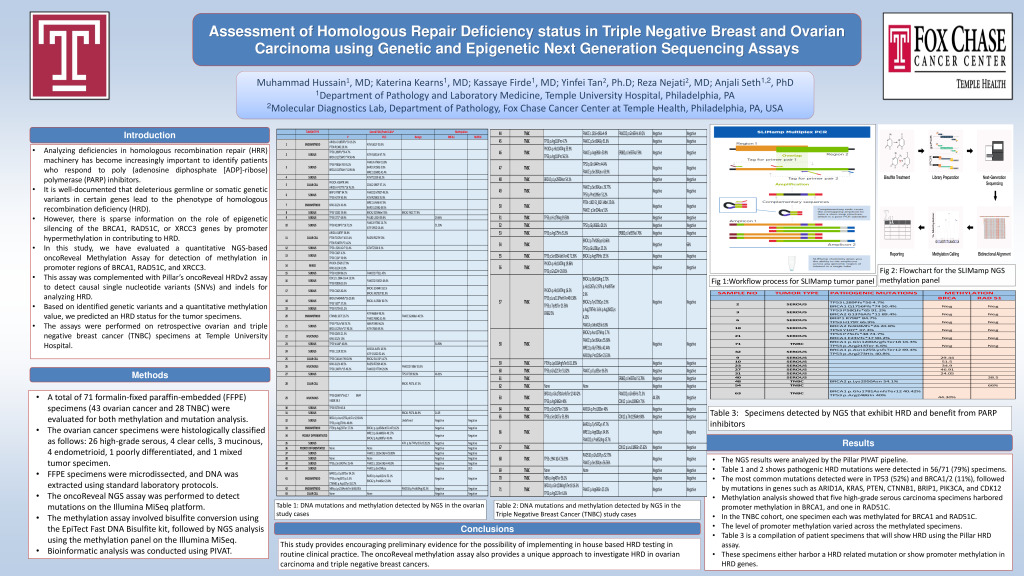
Temple University Hospital and Fox Chase Cancer Center paired Pillar’s oncoReveal® HRDv2 mutation panel with a quantitative oncoReveal® methylation assay to assess homologous recombination deficiency (HRD) — the phenotype predicting PARP inhibitor response — in retrospective ovarian and triple negative breast cancer (TNBC) specimens. Seventy-one FFPE samples (43 ovarian, 28 TNBC) were microdissected and tested for both pathogenic variants and BRCA1, RAD51C, and XRCC3 promoter hypermethylation on the Illumina MiSeq with PiVAT® analysis. Pathogenic HRD mutations appeared in 56 of 71 specimens (79%), and methylation flagged additional HRD-positive cases that mutation testing alone would have missed.
Combining State Space Models and Statistical Decision Theory forPrecision Profiling of Thalassemia
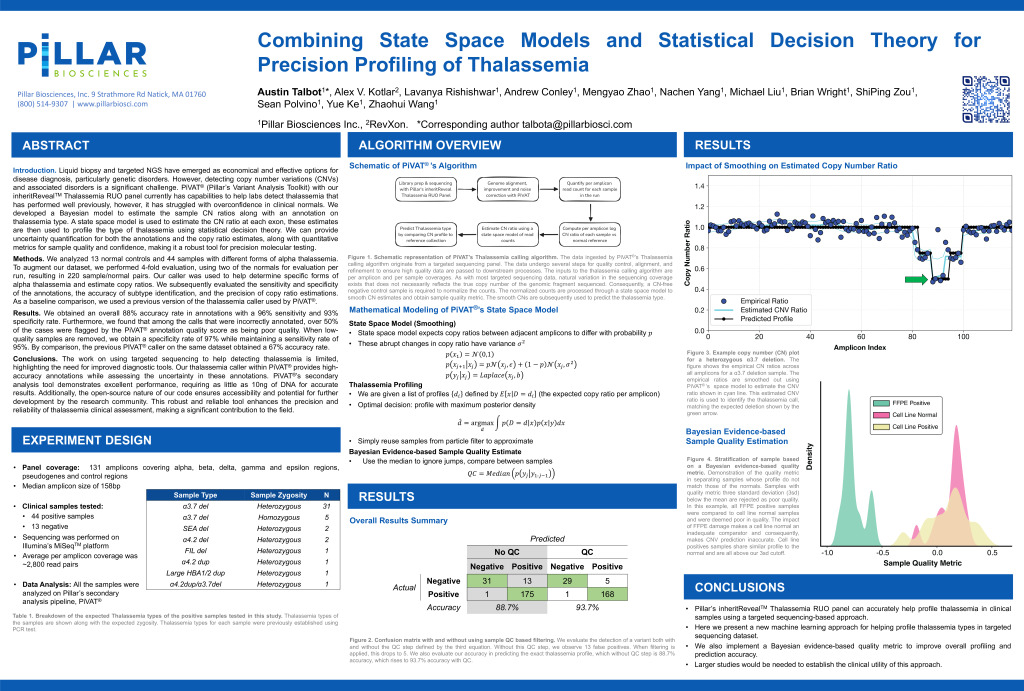
Pillar developed a Bayesian caller inside PiVAT® that pairs a state space model for copy number estimation with statistical decision theory to identify alpha thalassemia subtypes from the inheritReveal™ Thalassemia research-use panel. Thirteen normal controls and 44 alpha thalassemia samples were expanded to 220 sample/normal pairs by four-fold evaluation and sequenced on the Illumina MiSeq at roughly 2,800 read pairs per amplicon. The new caller reached 88% annotation accuracy with 96% sensitivity and 93% specificity, rising to 93.7% accuracy once its own quality metric filtered poor samples, against 67% for the previous PiVAT® caller.
Validation of a Rapid Targeted Next Generation Sequencing Oncology Panel
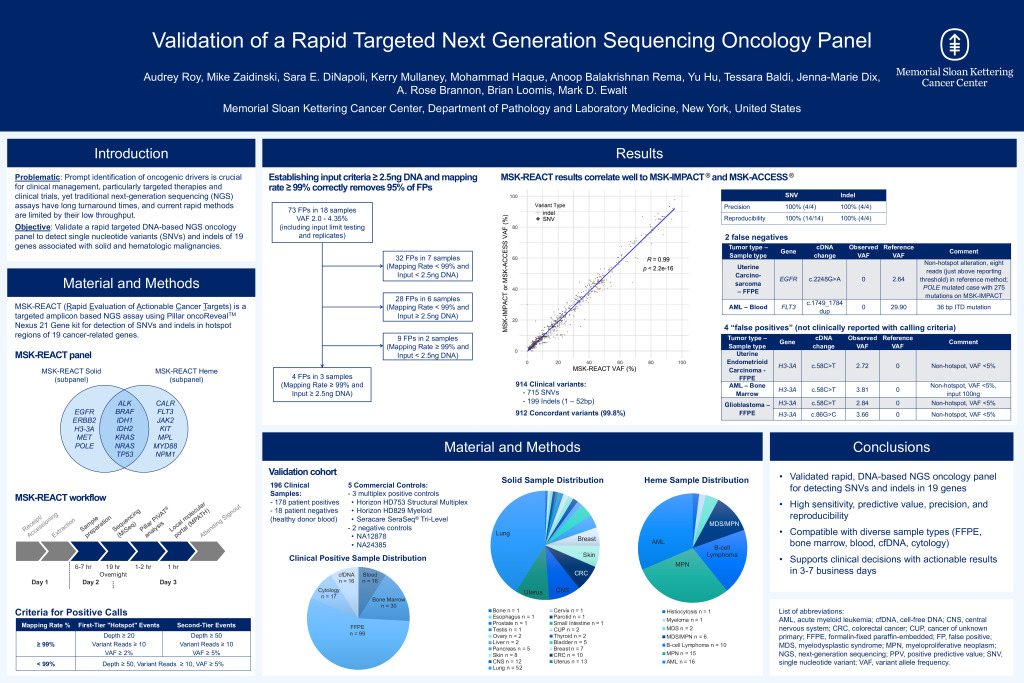
Memorial Sloan Kettering built MSK-REACT (Rapid Evaluation of Actionable Cancer Targets) on Pillar’s oncoReveal® Nexus 21 Gene kit, an amplicon NGS assay covering hotspot regions of 19 genes across solid and hematologic malignancies. Validation used 196 clinical samples — FFPE, bone marrow, blood, cytology, and cell-free DNA — plus five commercial controls, benchmarked against MSK-IMPACT® and MSK-ACCESS®. Of 914 clinical variants, 912 were concordant (99.8%), precision and reproducibility were both 100%, and actionable results are delivered in 3–7 business days.
Evaluation of the Pillar Biosciences oncoRevealTM Solid Tumor v2 (oRSTv2) Application on the Beckman Coulter Biomek NGeniuS System
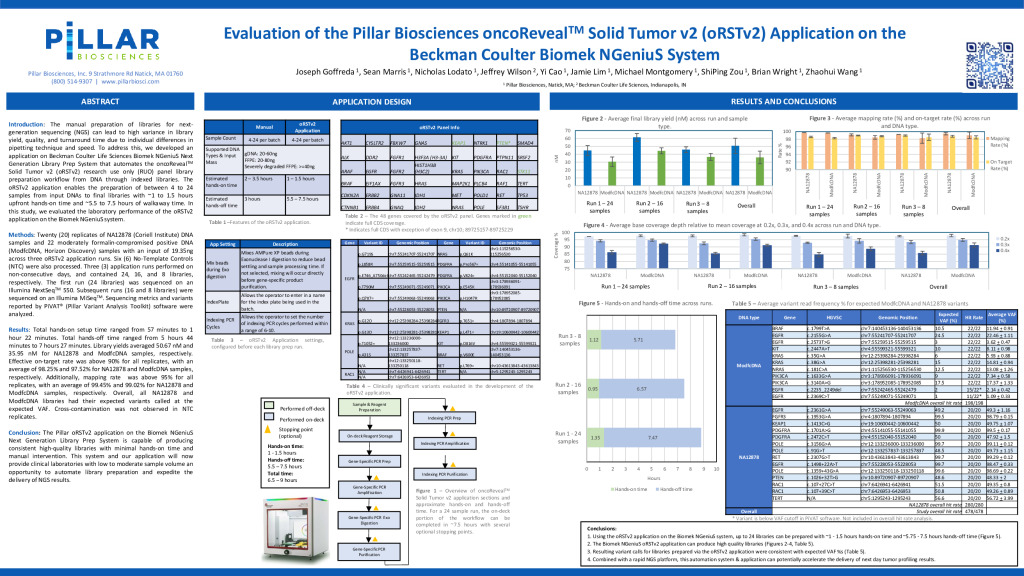
Pillar built and evaluated an automated application for its 48-gene oncoReveal® Solid Tumor v2 (oRSTv2) research-use panel on the Beckman Coulter Biomek NGeniuS library preparation system, taking DNA through to indexed libraries with minimal intervention. Twenty NA12878 replicates and 22 moderately formalin-compromised DNA samples at 19.35 ng input were processed across three runs of 24, 16, and 8 libraries, sequenced on Illumina NextSeq 550 and MiSeq with PiVAT® analysis. Every expected variant was called at its expected allele frequency — 478 of 478 across the study — with no cross-contamination in no-template controls.