
Performance Comparison of the Illumina MiSeq i100 with Established Instruments for Amplicon-Based Somatic and Liquid Biopsy Sequencing Panels
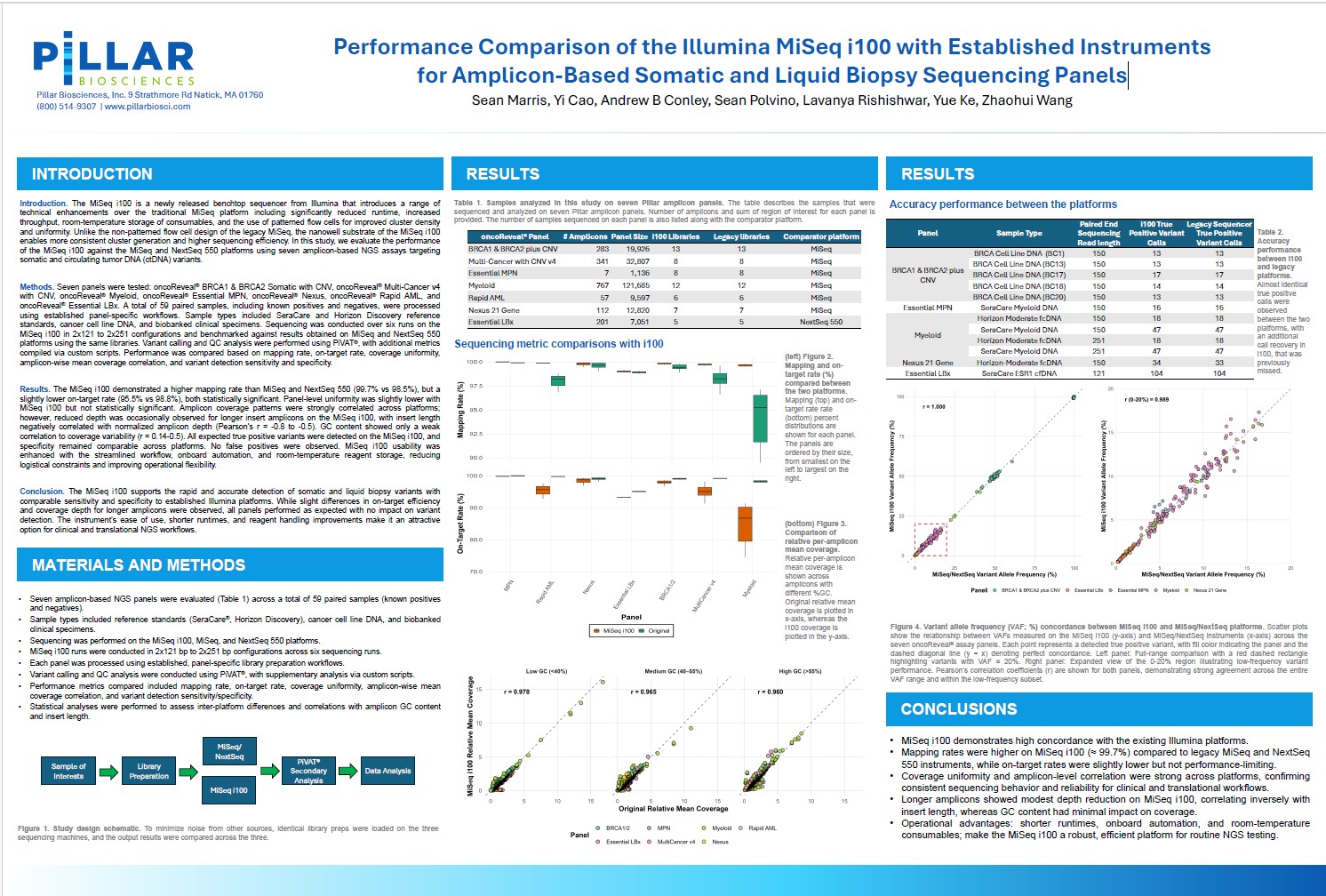
Pillar benchmarked seven oncoReveal® amplicon NGS panels — BRCA1/BRCA2 Somatic with CNV, Multi-Cancer v4 with CNV, Myeloid, Essential MPN, Nexus 21 Gene, Rapid AML, and Essential LBx — on Illumina’s new MiSeq i100 against the legacy MiSeq and NextSeq 550. Fifty-nine paired samples, including SeraCare and Horizon Discovery reference standards, cancer cell line DNA, and biobanked clinical specimens, were run from identical libraries across six sequencing runs. Every expected true-positive variant was detected on the i100 with no false positives, confirming that the portfolio transfers cleanly to the new platform.
From RUO to Trial-Ready in Six Months Accelerating an FGFR NGS Patient-Selection Assay for a Global Phase 3 Solid Tumor Cancer Trial
CellCarta Case Study
July 2026
Targeted NGS as a Frontline Strategy to Accelerate the Precision Treatment of Solid and Heme Tumors
Publication Source: GenomeWeb
TBC
Accelerating Precision Medicine with Rapid Front-Line NGS
Event Name: AMP 2025
TBC
Laboratory Validation of Pillar’s onocoReveal Myeloid Panel on the Illumina MiSeq i100 to Deliver Rapid Front-Line NGS for Heme Malignancies
Event Name: AMP 2025
TBC
Rapid Detection of Actionable Biomarkers in Liquid Biopsy from Non-Small Cell Lung Cancer and Breast Cancer Using Targeted NGS-Based Assays
Event Name: AMP 2025
TBC
Improving Access to NGS-Based Liquid Biopsy Testing for Advanced Cancers

Publishing Entity: GenomeWeb | Precision Medicine Online
TBC
Optimizing Your Lab’s Precision Medicine Strategy Through Rapid, Front-Line NGS

Publishing Entity: Dark Daily
TBC
Validation and Performance of Quantitative BRCA1 and RAD51C Promoter Hypermethylation Testing in Breast and Ovarian Cancers
Publication Source: The Journal of Molecular Diagnostics
TBC
Detecting Contamination in Cell-free DNA Sequencing Libraries using Germline Markers
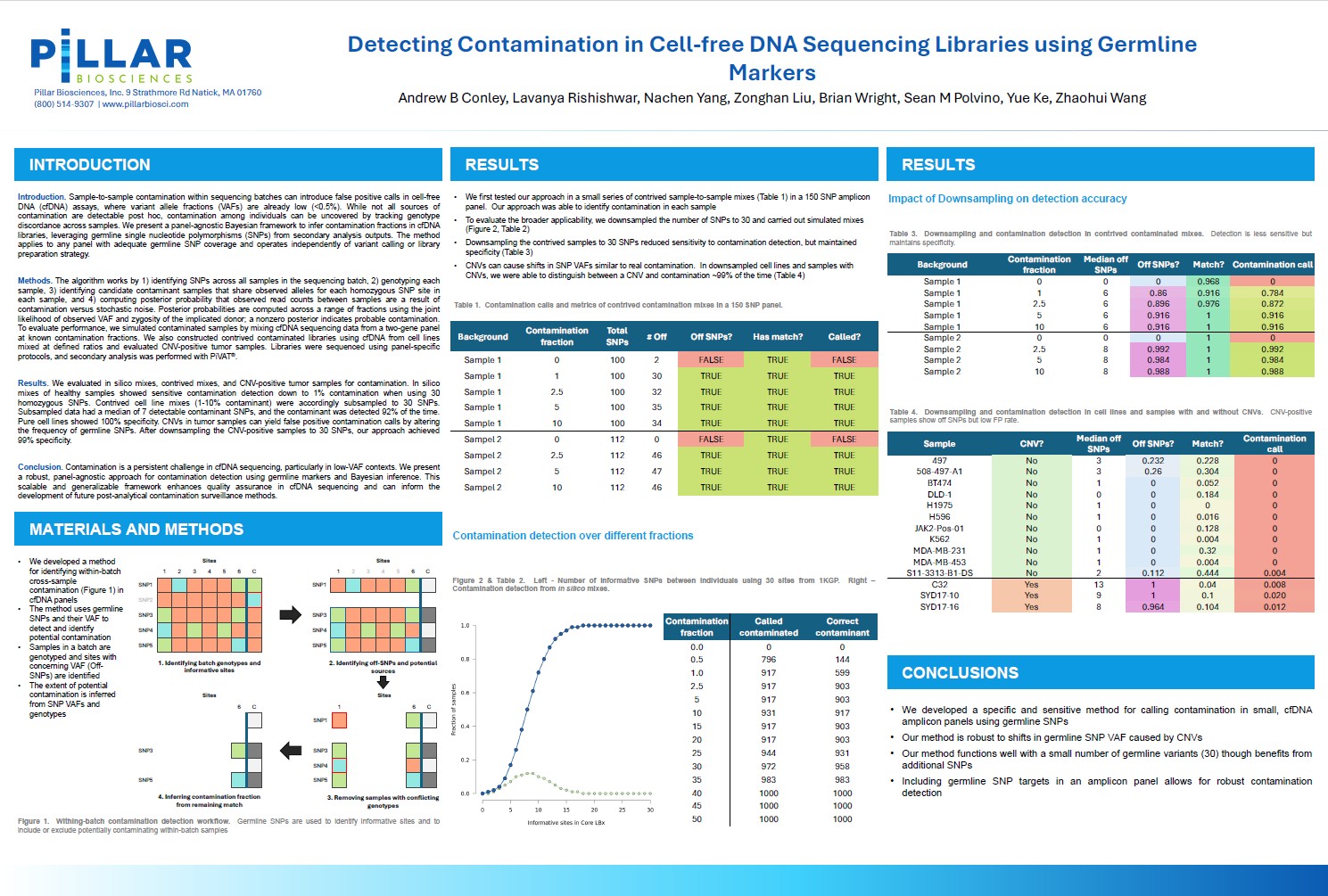
Pillar developed a panel-agnostic Bayesian method to detect sample-to-sample contamination within cell-free DNA (cfDNA) sequencing batches, where variant allele fractions below 0.5% make false positive calls especially costly. The algorithm genotypes germline single nucleotide polymorphisms (SNPs) across a batch, flags sites with discordant allele fractions, and computes the posterior probability that observed read counts reflect contamination rather than stochastic noise. Across in silico mixes, contrived cell line mixes, and CNV-positive tumor samples it detected contamination down to 1% using 30 homozygous SNPs while holding 99–100% specificity.