
Pillar oncoReveal Essential LBx Panel: Investigating the panel performance for hotspot ESR1 variants
Publication Source: Pillar Biosciences White Paper
TBC
Highly Accurate and Automated (RUO) NGS Assays for Efficient Localized LBx and TBx Testing in Oncology
Event Name: AMP 2023
TBC
Rapid Detection of Actionable Biomarkers in Liquid Biopsy from Non-Small Cell Lung Cancer and Breast Cancer Using Targeted NGS-Based Assays

Event Name: AMP 2025
TBC
From Innovation to Implementation: Redefining Breast Cancer Management with Liquid Biopsy

Event Name: AMP Europe 2026
TBC
Accelerating Access to Liquid Biopsy Testing with Kitted NGS Solutions

Publishing Entity: GenomeWeb | Precision Medicine Online
TBC
Improving Access to NGS-Based Liquid Biopsy Testing for Advanced Cancers

Publishing Entity: GenomeWeb | Precision Medicine Online
TBC
To UMI or not to UMI: Obtaining robust low-frequency variant identification for liquid biopsy with a SLIMamp-based NGS chemistry without molecular barcoding
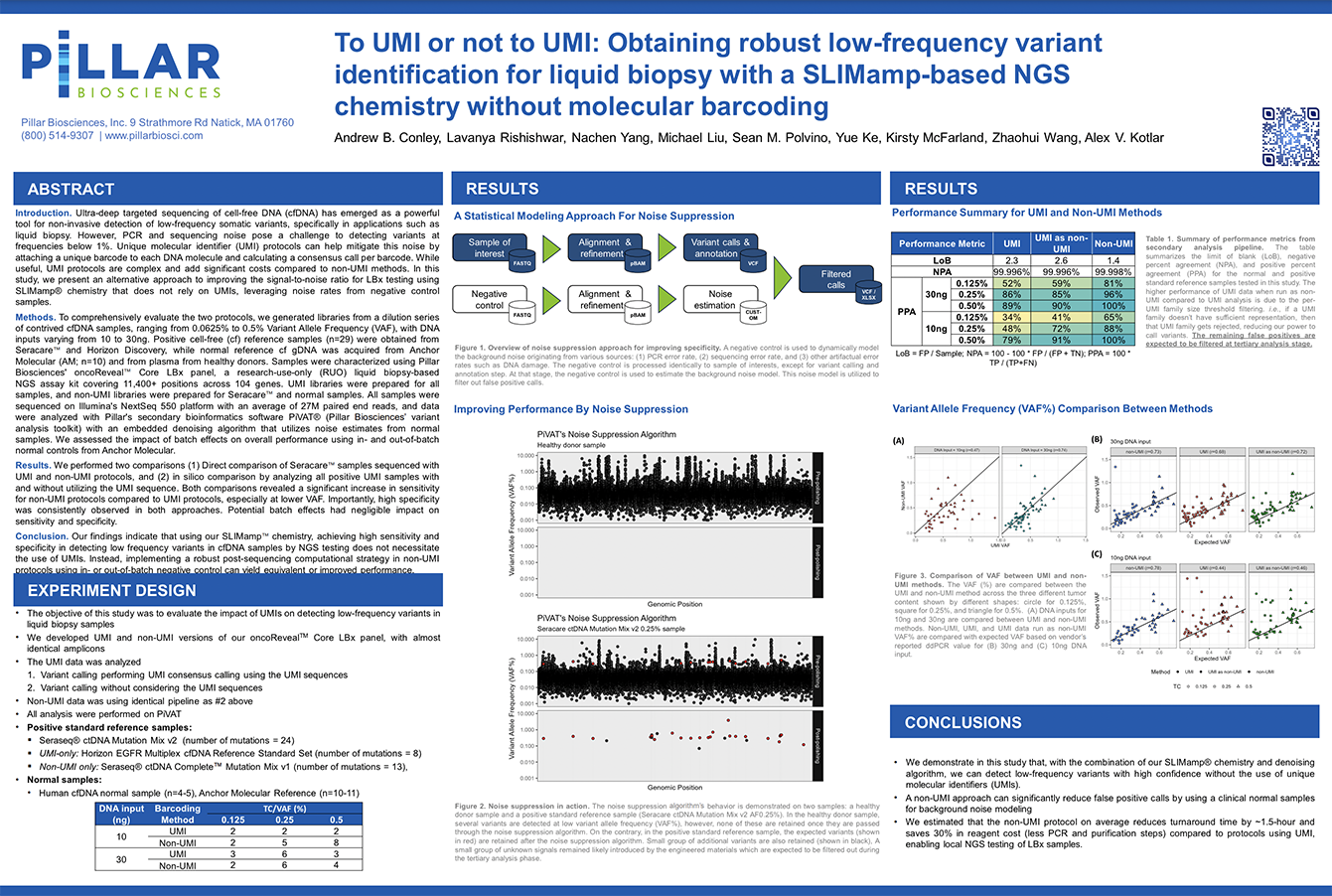
Pillar tested directly whether unique molecular identifiers (UMIs) are necessary for low-frequency variant detection in liquid biopsy, building UMI and non-UMI versions of the 104-gene oncoReveal® Core LBx panel with nearly identical amplicons. Contrived cell-free DNA dilutions from 0.0625% to 0.5% variant allele frequency at 10–30 ng input were sequenced on the Illumina NextSeq 550 and analyzed in PiVAT® using a denoising algorithm that models background noise from negative control samples. The non-UMI protocol was more sensitive than the UMI protocol at every allele frequency tested, while holding specificity above 99.99%.
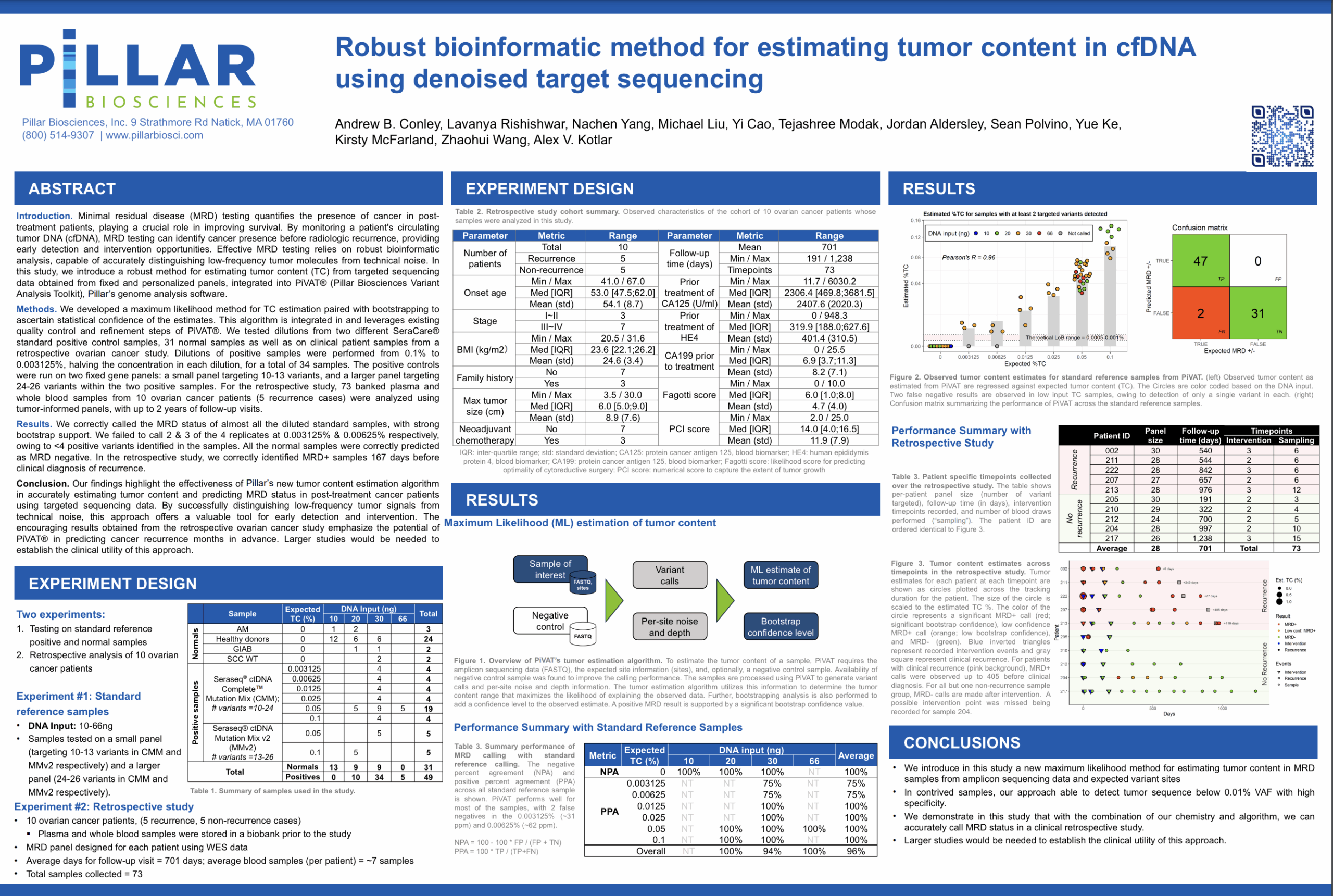
Robust bioinformatic method for estimating tumor content in cfDNAusing denoised target sequencing
Copy number amplifications are the hardest alteration class to call from cell-free DNA, usually demanding high circulating tumor DNA and broad genomic coverage. Pillar built oncoCNA, a Bayesian non-parametric caller inside PiVAT®, and tested it on Seraseq® ctDNA reference material across allele frequencies from 0.25% to 5% at 10, 20 and 30 ng input on the 104-gene oncoReveal® Core LBx panel. Performance was comparable at 10 ng and 30 ng, and the choice of negative control mattered more than input amount — clinical normal samples gave 100% negative percent agreement where synthetic normals did not.
Detection of Microsatellite Instability (MSI) Using oncoReveal Core LBx, a Multiplexed, Single Tube, Liquid Biopsy Assay
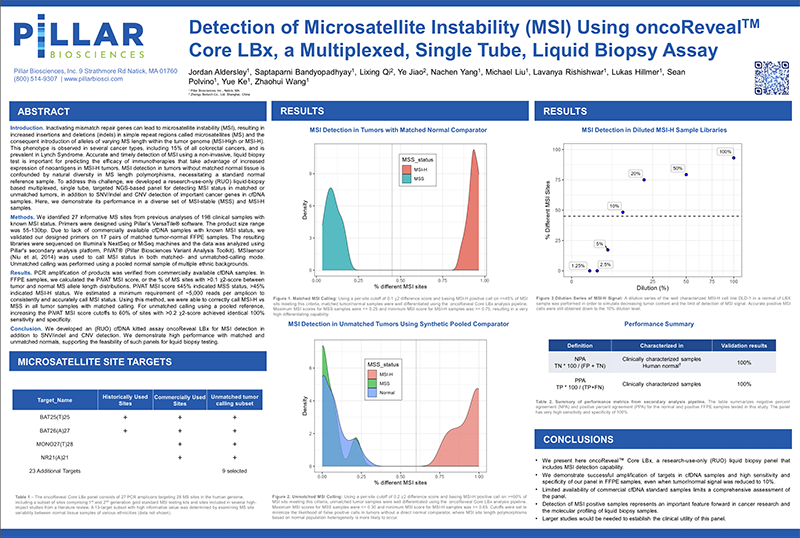
Pillar added microsatellite instability (MSI) detection to the research-use oncoReveal® Core LBx liquid biopsy panel alongside SNV, indel and copy number calling, supporting immunotherapy selection — MSI-high tumors respond to checkpoint inhibitors, and the phenotype appears in roughly 15% of colorectal cancers and across Lynch syndrome. Twenty-seven amplicons covering 28 microsatellite sites were validated on 17 matched tumor-normal FFPE pairs, sequenced on Illumina NextSeq or MiSeq and scored in PiVAT® using MSIsensor. Sensitivity and specificity were 100% in both matched and unmatched calling modes, with correct calls holding down to 10% tumor dilution.
Combining State Space Models and Statistical Decision Theory forPrecision Profiling of Thalassemia
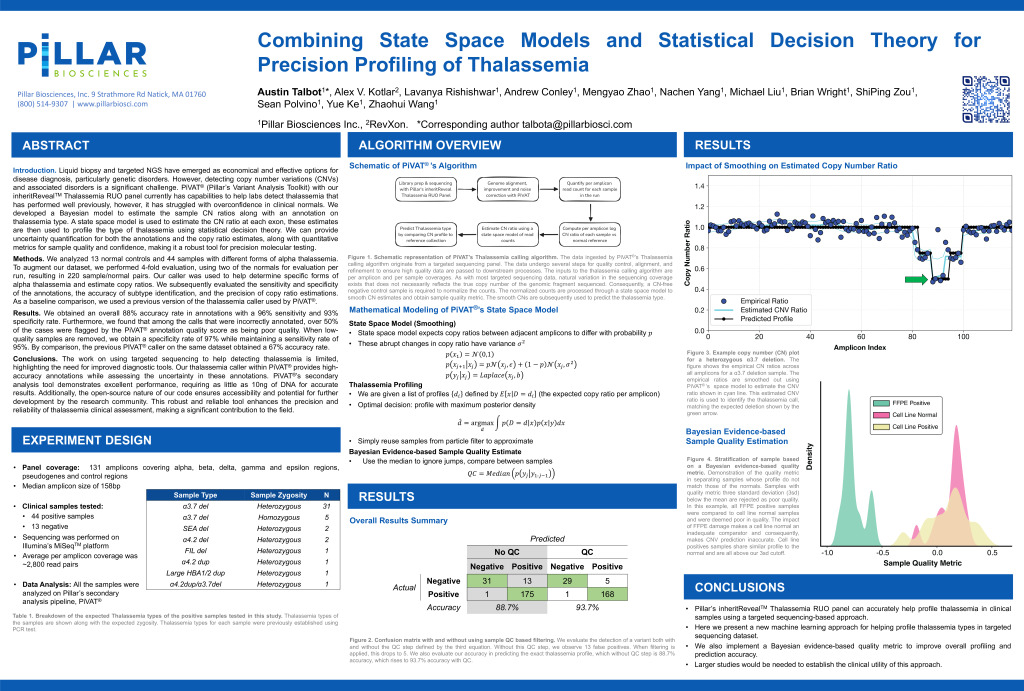
Pillar developed a Bayesian caller inside PiVAT® that pairs a state space model for copy number estimation with statistical decision theory to identify alpha thalassemia subtypes from the inheritReveal™ Thalassemia research-use panel. Thirteen normal controls and 44 alpha thalassemia samples were expanded to 220 sample/normal pairs by four-fold evaluation and sequenced on the Illumina MiSeq at roughly 2,800 read pairs per amplicon. The new caller reached 88% annotation accuracy with 96% sensitivity and 93% specificity, rising to 93.7% accuracy once its own quality metric filtered poor samples, against 67% for the previous PiVAT® caller.